7.2. Model Applications
7.2.1. Air Quality and Composition
Data related to all areas of atmospheric composition, including ozone, smoke, dust, AOD and PM2.5

EnsembleStat: Using Python Embedding for Aerosol Optical Depth
7.2.2. Climate
Average long range earth system predictions


7.2.3. Clouds
A category for use cases interested in the composition of, or characteristics associated with, clouds

GridStat: Cloud Fractions with Neighborhood and Probabilities

GridStat: Cloud Height with Neighborhood and Probabilities


GridStat: Cloud Fractions with Neighborhood and Probabilities

GridStat: Cloud Fractions with Neighborhood and Probabilities

GridStat: Cloud Fractions with Neighborhood and Probabilities
7.2.4. Data Assimilation
Observational data used as part of the initial conditions for numerical weather prediction


7.2.5. Land Surface
Land Model diagnostics and verification against observations

PointStat: CESM and FLUXNET2015 Terrestrial Coupling Index (TCI)
7.2.6. Marine and Cryosphere
Data related to verification involving marine and cryosphere systems, which includes sea-ice

GridStat: Python Embedding for sea surface salinity using level 3, 1 day composite obs


GridStat: Python Embedding to read and process SST

GridStat: Python Embedding to read and process sea surface heights

UserScript: Python Script to compute cable transport

PlotDataPlane: Python Embedding of tripolar coordinate file

GridStat: Python Embedding to read and process ice cover

PointStat: read in buoy ASCII files to compare to model wave heights


GridStat: Python Embedding for sea surface salinity using level 3, 8 day mean obs
7.2.7. Medium Range
Lower resolution model configuration (>4km) usually producing forecasts out to 7-14 days (also referred to as global models)

Multi_Tool: Feature Relative by Lead (with lead groupings)

Grid-Stat: Standard Verification of Surface Fields

GridStat: Use binary observation field to verify percentile forecast

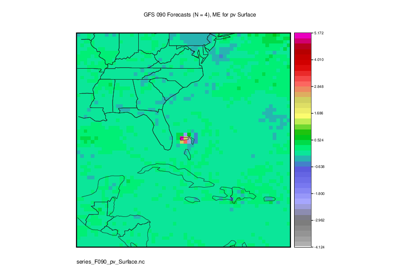
Multi_Tool: Feature Relative by Lead using Multiple User-Defined Fields

Point-Stat: Standard Verification of Global Upper Air


Multi_Tool (MTD): Feature Relative by Lead (with lead groupings)

Point-Stat: Standard Verification for CONUS Surface

Grid-Stat: Compute Anomaly Correlation using Climatology
7.2.8. Planetary Boundary Layer
Planetary Boundary Layer (PBL) applications

GenVxMask and Point-Stat: Computing PBLH from AMDAR data using “Theta-increase” method
7.2.9. Precipitation
Any fields that can be defined as precipitation, including rain, snow, and other precipitation types


MTD: Build Revision Series to Evaluate Forecast Consistency


PointStat: Compare community observed precipitation to model forecasts
7.2.10. Subseasonal to Seasonal
Subseasonal-to-Seasonal model configurations; Lower resolution model configurations (>4km) usually producing forecasts out beyond 14 days and up 1 year

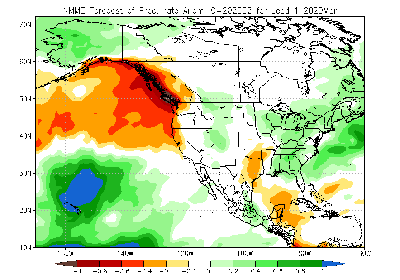
Grid-Stat and Series-Analysis: BMKG APIK Seasonal Forecast

TCGen: Genesis Density Function (GDF) and Track Density Function (TDF)


GridStat: Determine dominant ensemble members terciles and calculate categorical outputs

SeriesAnalysis: Standardize ensemble members and calculate probabilistic outputs
7.2.11. Subseasonal to Seasonal: Mid-Latitude
Subseasonal-to-Seasonal model configurations relating to middle latitudes

Blocking Calculation: ERA RegridDataPlane, PcpCombine, and Blocking python code

WeatherRegime Calculation: ERA RegridDataPlane, PcpCombine, and WeatherRegime python code

Blocking Calculation: GFS and ERA RegridDataPlane, PcpCombine, and Blocking python code

WeatherRegime Calculation: GFS and ERA RegridDataPlane, PcpCombine, and WeatherRegime python code
7.2.12. Subseasonal to Seasonal: Madden-Julian Oscillation
Subseasonal-to-Seasonal model configurations relating to the Madden-Julian oscillation

UserScript: Make a Phase Diagram plot from input RMM or OMI

UserScript: Make OMI plot from calculated MJO indices

UserScript: Make MaKE-MaKI plot from calculated MaKE and MaKI indices

UserScript: Make OMI plot from calculated MJO indices

UserScript: Make RMM plots from calculated MJO indices
7.2.13. Short Range
High resolution model configurations (1-4km) usually producing forecasts between 0-3 days (also referred to as limited area models, stand-alone regional, and short range weather applications); Previously named Convection Allowing Models

UserScript: Physics Tendency Vertical Profile plot


Grid-Stat: Surrogate Severe and Practically Perfect Evaluation


UserScript: Physics Tendency Vertical Cross Section plot


Point2Grid: Calculate Practically Perfect Probabilities

Ensemble-Stat: Ensemble Statistics using Obs Uncertainty


MODE/Grid-Stat: Brightness Temperature Verification and Distance Maps

Grid-Stat: Surrogate Severe and Practically Perfect Probabilistic Evaluation

Surrogate Severe Calculation: PCPCombine, GenEnsProd, and RegridDataPlane
7.2.14. Space Weather
Upper atmosphere and geospace model configurations


7.2.15. Tropical Cyclone and Extra Tropical Cyclone
Any field that is associated with Tropical Cyclone and Extra-tropical Cyclones


Track and Intensity Plotter: Generate mean, median and box plots

Grid-Stat: Verification of TC forecasts against merged TDR data

CyclonePlotter: Extra-TC Tracker and Plotting Capabilities

Point-Stat: Standard Verification for CONUS Surface

TCGen: 2021 Global Forecast System (GFS) Tropical Cyclone Genesis Forecast

CycloneVerification: TC Verification Compare ADECK vs BDECK

7.2.16. Unstructured Grids
Unstructured grids used by models for numerical weather prediction.
